DynamoDB
- Managed service.
- You start by creating tables and not database itself.
- NoSQL DBMS.
- Try to avoid needing relations and joins.
- Check the learn more section.
- Scalable.
- Distributed serverless database.
- Low latency retrieval.
- We can activate its Auto Scaling feature.
- We can run it locally too on Docker (learn more).
- Encrypts your Data at REST, meaning if someone goes to an AWS data center and tears out a drive, the data stored on it is encrypted.
Encryption VS Hashing
Suppose you have a password field. Now we know that AWS DynamoDB encrypts my data before storing it on the physical hard drive but when my AWS admins are fetching data AWS will send a decrypted version, so they can see it in plain text.
But that’s not the point, what we need to do is hashing our password field with a resilient algorithm against ASICs attacks. For example Argon2, you can find its implementation in JS here.
Encryption
Sometimes we have regulatory compliance requirements that asks us to encrypt data on top of data being encrypted at REST.
[!TIP]
It’s a good idea to always know what kind of regulations do we need to meet.
DynamoDB Accelerator – DAX
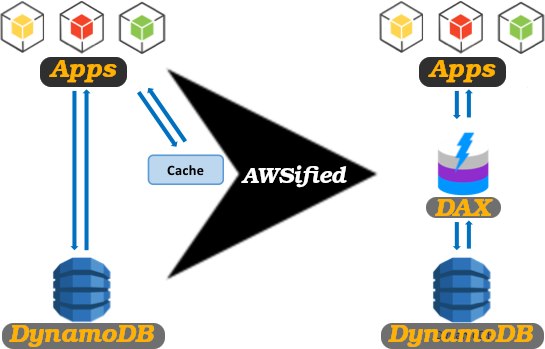
- A managed service.
- An in-memory caching solution for DynamoDB.
Partition Key, Sort Key, and Primary Key
-
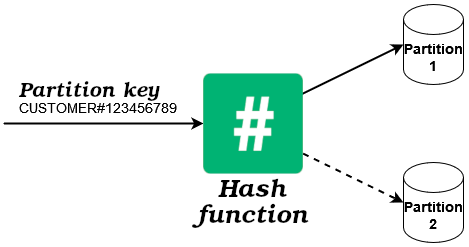
Partition key:
-
What determines in which partition data should be stored.
-
- Sort key:
- Dictates records sorting in each partition.
- Primary key:
- A unique identifier for each document in my DynamoDB.
- Can be:
- A normal primary key: partition key.
- A composite key: partition key + sorting key.
[!TIP]
Your primary key needs to be selected in a way that it is not gonna create hot partitions where one or a couple of partitions have to handle a lot of data while others do not have much data.